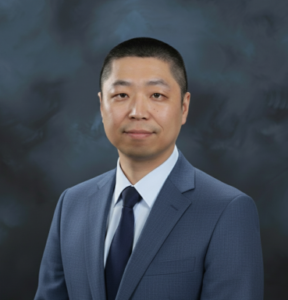
Dr. Yan Wang is an R&D Staff Member in the Quantum Computational Science Group at the Oak Ridge National Laboratory. He holds a bachelor’s degree in physics from Fudan University and a Ph.D. in Theoretical Condensed Matter Physics from the University of Florida. Dr. Wang’s current research focuses on leveraging quantum computers to solve complex quantum many‑body problems essential for the understanding and development of new materials and phases of matter. His expertise and interest spans developing quantum algorithms, designing efficient quantum circuits, and creating software for quantum error mitigation and correction. Currently, he leads entanglement-enhanced quantum sensing LDRD project and sampling-based methods Quantum Science Center project. Prior to his work in quantum computing, Dr. Wang applied quantum many-body theoretical and computational methods to study strongly correlated materials, including high-temperature superconductors.
Presentation Title:
Codesign of Entanglement-Enhanced Quantum Sensing Protocols
Presentation Abstract:
Quantum sensing is categorized by three distinct methodologies: Type-I sensors utilize quantized energy levels to probe physical quantities, Type-II sensors employ quantum coherence through superposition states, and Type-III sensors leverage quantum entanglement to surpass classical sensitivity limits. Operating at room temperature, the nitrogen-vacancy (NV) center in diamonds is a versatile quantum sensor that can be used as all three types. I will briefly introduce our recently published work using a single NV center as a Type-I sensor to map boron vacancies in a 2D material. Then, I will discuss how to use the NV center as a Type-II or III sensor by generating quantum coherence and entanglement between the NV electron spin and nitrogen nuclear spin, which constitute a two-qubit (four-level) quantum system. We use selective microwave (MW) and radiofrequency (RF) drives between the four hyperfine coupling levels of the system as the main entangling protocol. This allows us to prepare maximally entangled Bell states, perform correlated measurements, and repetitively read out the quantum eigenstate stored in the memory nuclear spin register with a long coherence time. These protocols enable enhanced sensitivity in multiparameter sensing (such as vector field measurement) and high-fidelity single-shot readout. Our work will expand the capability of the scanning NV microscope at CNMS.