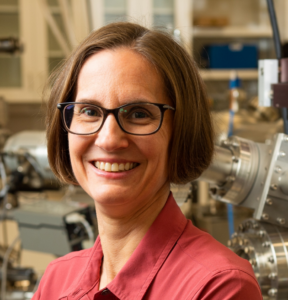
Dr. Tiffany Kaspar is a Materials Scientist and Team Lead at Pacific Northwest National Laboratory. Her expertise centers on the deposition and systematic characterization of epitaxial films to provide insight into the physics underlying observed phenomena. The role of intentional and unintentional defects on film structure and properties is a running theme through Dr. Kaspar’s work. Dr. Kaspar is capitalizing on the advent of artificial intelligence (AI) and machine learning (ML) algorithms to enhance scientific data analysis by developing AI/ML approaches to analyze, in real time, reflection high energy electron diffraction (RHEED) data collected during epitaxial film deposition and use this information to execute intelligent feedback control decisions. Dr. Kaspar received her B.S. in Chemical Engineering from the University of Colorado and her Ph.D. in Chemical Engineering from the University of Washington. She is a Fellow of AVS and has co-authored more than 120 publications.
Presentation Title:
Improving quantum materials synthesis: Artificial intelligence for on-the-fly analysis and control during oxide molecular beam epitaxy
Presentation Abstract:
We employ artificial intelligence (AI)-accelerated analysis of in situ data streams for on-the-fly feedback control of the molecular beam epitaxy (MBE) deposition process that will enable successful synthesis of novel materials with desired structure and functional properties. Deposition by MBE typically employs reflection high energy electron diffraction (RHEED) as a real-time in situ probe of the growing film. However, the state of the art for RHEED analysis requires meticulous human observation and often fails to avoid negative film outcomes. Here we present a machine-learning-enabled framework for the analysis of RHEED pattern images in real time (one image per second). We demonstrate this framework using RHEED images collected from the deposition of epitaxial oxide thin films such as anatase TiO2 on SrTiO3(001). On-the-fly feedback control of the deposition process is shown to improve film outcomes. The incorporation of forecasting approaches to predict future RHEED pattern evolution will also be discussed.