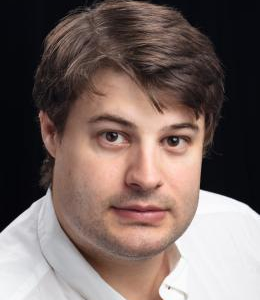
Matthew A. Feldman is a staff scientist in the Quantum Information Science Section at Oak Ridge National Laboratory and a researcher in the DOE Quantum Science Center. His research focuses on continuous-variable and photonic quantum information, including cluster-state architectures, quantum compilation, and quantum sensing. He is interested at the intersection of theory, quantum-optics experiments, scientific computing, and artificial intelligence to develop scalable quantum systems and reduce implementation overhead. Feldman earned his Ph.D. in physics from Vanderbilt University, where he studied solid-state single-photon emitters as a National Defense Science and Engineering Graduate Fellow and a Quantum Information Science and Engineering Network Fellow. He earned his B.S. in electrical engineering from the University of Florida and worked as a radio-frequency engineer before graduate school.
Presentation Title:
Spatially Multiplexed Continuous-Variable Cluster-State Generation
Presentation Abstract:
Continuous-variable cluster states are a resource for measurement-based quantum computing, but leading scalable photonic approaches have primarily used temporal or frequency multiplexing. We present a spatial-multiplexing approach based on four-wave mixing in rubidium-85 vapor. Phase matching supports independently addressable probe–conjugate coherence areas within a single nonlinear medium, allowing multiple two-mode squeezed states to be generated in parallel. Interfering two probe modes on a balanced beam splitter produces the connectivity associated, after measurement-basis phase rotations, with a four-mode cluster graph.
We describe how the finite-squeezing Gaussian graph can be reconstructed from homodyne covariance data and how its real adjacency and residual-noise components distinguish the intended graph from unwanted correlations. In preliminary measurements, the two source pairs exhibit 1.9 and 2.7 dB of intensity-difference squeezing relative to shot noise. After interference, the mixed-mode combinations show noise approximately 3 dB below the uncorrelated excess-noise baseline, consistent with the predicted redistribution of correlations. These results are a connectivity consistency check, not yet a nullifier or multipartite-entanglement witness. Full graph certification requires joint-quadrature homodyne measurements. We also outline scaling to larger dual-rail cluster graphs through additional spatial-mode addressing and passive interference.