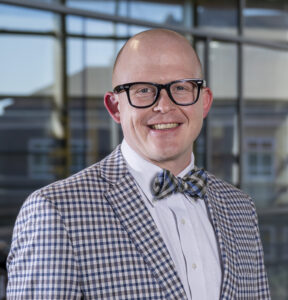
Joseph M. Lukens received the BS degree in electrical engineering and physics in 2011 from the University of Alabama, Tuscaloosa, and the PhD degree in electrical engineering from Purdue University, West Lafayette, Indiana, in 2015. Employed as a Wigner Fellow and Research Scientist at Oak Ridge National Laboratory (ORNL) from 2015–2022 and then as Senior Director of Quantum Networking at Arizona State University (2022–2024), he joined Purdue University in January 2025 as an associate professor, where he maintains a joint faculty appointment at ORNL. His research interests encompass a variety of topics in photonic quantum information processing, optical networking, and Bayesian inference, with accomplishments including the Paul Baran Young Scholar Award from the Marconi Society (2015), the Early Career Award from the U.S. Department of Energy (2019), and the Presidential Early Career Award in Science and Engineering from the White House (2025).
Presentation Title:
Frequency bins and integrated photonics: the quantum rainbow connection
Presentation Abstract:
Among the many photonic degrees of freedom available for encoding quantum information, frequency bins offer unique synergies with integrated photonics, where microring resonators can generate, multiplex, and manipulate “quantum rainbows”—states of light in which photons carry information in superpositions of discrete colors. Yet despite such promising overlap, frequency bins continue to trail the maturity of more traditional on-chip encodings. In this talk, I will present a vision to close this gap via the quantum frequency processor (QFP), a paradigm leveraging pulse shapers and modulators for universal quantum information processing. After summarizing key tabletop experiments, I will describe a blueprint for fully on-chip frequency-bin photonics, highlighting recent experimental results in hyperentanglement and line-by-line pulse shaping, theoretical developments on optimizing biphoton sources, and an unconventional acousto-optic paradigm known as the FRequency-mODe Operation (FRODO). Throughout, I hope to show that the quantum “rainbow connection” between frequency encoding and on-chip photonics can unlock a future of microring-centric on-chip quantum information processing.