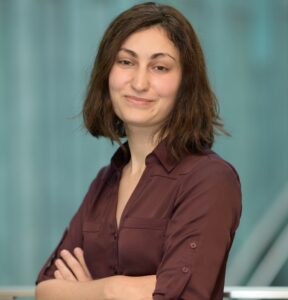
Gayane Vardoyan is an Assistant Professor at the College of Information and Computer Sciences, University of Massachusetts Amherst. Previously, she was an Assistant Professor at QuTech’s Quantum Internet Division, and EEMCS, TU Delft. Prior to this, she was a postdoc researcher at TU Delft, where she worked with Prof. Stephanie Wehner. Vardoyan received her PhD from the University of Massachusetts Amherst, where she worked in systems and networking. Her PhD advisor was Prof. Don Towsley. Vardoyan’s research interests currently focus on the modeling, performance analysis, and control of distributed quantum systems. She received her Master of Science in 2017 from UMass Amherst and her Bachelor of Science in Electrical Engineering and Computer Sciences from the University of California at Berkeley. Previously, she worked at the Argonne National Lab and the Computation Institute at the University of Chicago.
Presentation Title:
Learning to Control Quantum Networks
Presentation Abstract:
Near-term quantum networks have limited capabilities, but even as quantum hardware matures, it may never provide conveniences that we take for granted in conventional architectures. Imperfect quantum memories, noisy operations, and lossy communication fundamentally limit network performance. Given this reality, much of the theoretical quantum networks community has been trying to bridge the technological shortcomings gap through the design of algorithms that optimize protocol deployment on constrained quantum architectures. In this talk, I will focus on two problems in quantum network control: the first is that quantum applications often draw utility from the network in mathematically complex ways, making optimization with existing techniques difficult. The second is that quantum networks can have a large number of configurable parameters over which to optimize, making exhaustive search intractable. For the first problem, I will present a novel reinforcement learning framework that can accommodate complex performance objectives; and for the second problem, I will present a surrogate-guided optimization method to efficiently configure quantum networks. I will conclude the talk with open questions in quantum network control where learning-based methods may provide useful solutions.