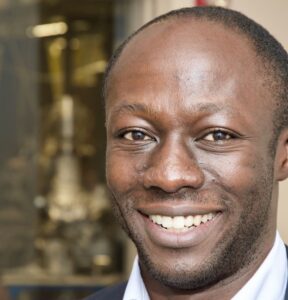
Divine Kumah is the Charles H. Townes Associate Professor of Physics at Duke University. He earned a B.S. in Physics from Southern University and A&M College in Baton Rouge, Louisiana, and a Ph.D. in Applied Physics from the University of Michigan in 2009. He subsequently conducted postdoctoral research at Yale University’s Center for Research on Interface Structures and Phenomena. Prior to joining Duke University in 2023, he was an Associate Professor of Physics at North Carolina State University. His research focuses on experimental condensed matter physics, with an emphasis on understanding and controlling the emergent electronic and magnetic phenomena that arise at interfaces in complex crystalline materials. Dr. Kumah’s contributions have been recognized with several honors, including a National Science Foundation CAREER Award and the 2022 Oxide Electronics Prize for Excellence in Research.
Presentation Title:
Emergent Superconductivity at Oxide Heterointerfaces
Presentation Abstract:
Two-dimensional materials exhibit a wide range of exciting electronic and magnetic phenomena, including superconductivity and multiferroicity, arising from interactions at atomic and subatomic scales. To understand and harness the unique properties of these materials, precise tools for creating and characterizing these systems with atomic-scale precision are required. This talk will introduce the atomic-scale synthesis of 2D materials and high-resolution synchrotron X-ray probes for mapping out the structural, electronic, and magnetic properties of these materials. Understanding the complex interactions between these properties enables us to develop rigorous frameworks for predicting the electronic and magnetic properties of materials, and design the next generation of materials and devices that will revolutionize the development of quantum computing devices.
This presentation will explore the intimate connection between interface-driven atomic-scale distortions and the physical properties of low-dimensional systems. It will focus on two specific cases where metallicity and superconductivity emerge at interfaces formed between nominally insulating materials.
Firstly, we will discuss recent findings on anisotropic superconductivity at KTaO₃ interfaces. Secondly, we will examine how structural reconstructions at interfaces formed by the charge-ordered insulator BaBiO₃ play a crucial role in stabilizing two-dimensional superconductivity.
Guided by first-principles theory, this talk will highlight how atomic-scale materials growth techniques and state-of-the-art methods for characterizing the physical properties at the picometer scale provide a powerful approach for discovering novel quantum materials.