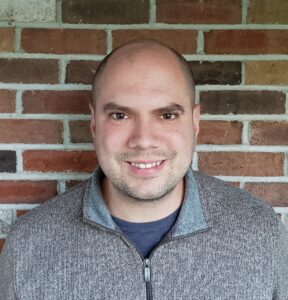
David Hucul earned his PhD at the University of Maryland under Professor Chris Monroe where he built the first ion trap mini quantum network with gates within and across two network nodes. In 2015, David started a post doc at UCLA under Wesley Campbell and Eric Hudson. David developed the first barium 133 qubit, an ideal candidate qubit for quantum networking. Now David leads the ion trap group at AFRL in Rome where he works on building quantum networks to create entanglement between different qubit types.
Presentation Title:
Heterogeneous Quantum Networks
Presentation Abstract:
Heterogeneous Quantum Networks can offer avenues for scaling quantum processors and increasing sensor capability by connecting different qubit types. The highest entanglement rate achieved between quantum nodes with identical memory qubits is of order 100 sec-1 and is limited by the entanglement attempt rate, light collection and detection efficiency, and the use of single photonic links. In heterogeneous networks, this speed will decrease because photons must be converted to a common network wavelength and wavepacket shape. We present an architecture and progress toward achieving high-speed connections in these networks using photonic chips, enabling simultaneous multiplexing in space and time. This approach promises to increase the entanglement rate between network nodes by many orders of magnitude and offers practical ways to address the challenges of constructing heterogeneous quantum networks.