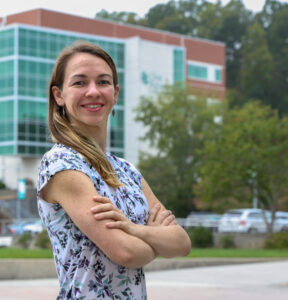
Claire Marvinney is an early career staff scientist at Oak Ridge National Laboratory in the Quantum Information Science Section where she currently studies quantum light sources for quantum sensing and transduction experiments. This includes developing novel sensing and transduction platforms and studying the integration these light sources with practical cryogenic environments. She also works as a coordinator of the Quantum Computing User Program at ORNL, where she manages the quantum resource utilization council. She first joined ORNL in 2018 as an Intelligence Community Postdoctoral Fellow, where she worked on the development of a millikelvin optical microscopy system in order to study quantum materials at cryogenic temperatures. Her PhD is in Interdisciplinary Materials Science from Vanderbilt University and her BS is in Physics from Rensselaer Polytechnic Institute.
Presentation Title:
Optomechanical Devices for Quantum Transduction
Presentation Abstract:
There is a need to develop novel quantum devices at the interface of material science and QIS that can serve as a platform for quantum technologies. Of particular importance is the development of devices for quantum transduction to connect heterogeneous quantum systems, such as quantum sensors and quantum computers based on different quantum platforms, over a network. Quantum transduction has been consistently highlighted as a need for the scalability and to increase capabilities of quantum systems. Here, we seek to address current gaps in the development of such devices and to deliver the groundwork for optomechanical quantum transduction at ORNL. We present our current optomechanical device designs, based on trampoline resonators, and their characterization. These trampoline resonator devices target MHz frequencies and will be used to transduce optical to microwave signals. Beyond the focus on quantum transduction, the applicability of the proposed platform to quantum sensing will benefit other science domains, such as high energy physics, national security, and materials characterization.