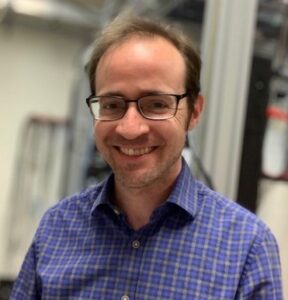
Christopher Yale is a Principal Member of the Technical Staff at Sandia National Laboratories in Albuquerque, NM. He is the experimental operations lead for Sandia’s trapped-ion quantum processor, the Quantum Scientific Computing Open User Testbed, part of the DOE ASCR Quantum Testbed Program. His research interests focus on trapped-ion quantum computing, including developing hybrid qubit-boson computing for trapped-ion hardware, investigating noise-aware circuit compilation strategies, and exploring novel quantum gate implementations and designs. Prior to joining Sandia in 2016, he received his PhD from the University of California, Santa Barbara researching optical control of NV centers in diamond both there and at the University of Chicago.
Presentation Title:
Spins and Ladders: Building Qubit-Boson Computing in the QSCOUT Trapped-Ion Testbed
Presentation Abstract:
Exploiting quantum resources beyond discrete-variable qubits offers a promising route toward more efficient quantum computation. Specifically, coupling bosonic modes to qubits introduces quasi-continuous-variable resources that can enable efficient simulation of fermion-boson processes inherent to nuclear, high-energy, and condensed-matter physics. Hybrid qubit-boson architectures are being explored across qubit modalities, including superconducting qubits coupled to microwave resonators, neutral atoms in optical tweezers, and trapped ions coupled to the collective phonon modes of the ion chain. Here, I will describe the development of qubit-boson computing in Sandia’s trapped-ion testbed, the Quantum Scientific Computing Open User Testbed (QSCOUT). In collaboration with our user teams, we developed a gateset that includes Jaynes-Cummings, anti-Jaynes-Cummings, conditional displacement, conditional beamsplitter, and conditional squeeze gates within a small register of ions. Harnessing this gateset, I discuss progress toward simulations of the Generalized Resonant Rabi model, the sine-Gordon model, the massive static Yukawa model, as well as the observation of Aharanov-Anandan phase.