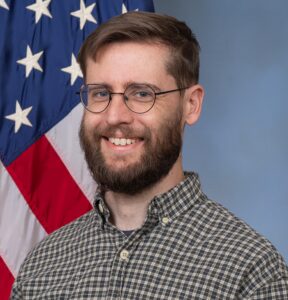
Dr. Brian T. Kirby leads quantum networking research for the Tactical Network Assurance Branch at the DEVCOM Army Research Laboratory (ARL). His work focuses on applying distributed quantum systems to critical DoD challenges in synchronization, communication, and distributed sensing. As a recognized advisor in the quantum information science community, Dr. Kirby serves on the OSTP Quantum Networking Interagency Working Group and the NATO IST-219 on Quantum Technology Vulnerabilities. His previous advisory roles include the TTCP Quantum Communication Working Group and the NATO IST-SET-198 on Quantum Technology. Dr. Kirby earned his Ph.D. and M.S. in Physics from the University of Maryland, Baltimore County, and his B.S. in Physics from Towson University.
Presentation Title:
Quantum state characterization via machine learning
Presentation Abstract:
Characterizing high-dimensional quantum states and classical optical channels is fundamentally constrained by exponential physical scaling and the computational overhead of post-processing. Here we present machine learning as a unifying approach to overcome these bottlenecks, demonstrating how neural networks and support vector machines (SVMs) enable efficient full and partial system characterization. We first focus on full system characterization, demonstrating a convolutional neural network (CNN) designed for quantum state tomography (QST) that frontloads expensive computational overhead into a pre-training phase, showing strong robustness against experimental noise and missing measurements. Next, we apply a CNN approach to classical channels to demonstrate the characterization and post-processing mitigation of atmospheric turbulence and thermal noise in free-space optical communications, significantly reducing bit error rates. We then move to partial system characterization and present an SVM-based framework to generate entanglement witnesses. Finally, we discuss complementary techniques developed to bypass the scaling and computational limits of QST, including our work on projected classical shadows which augments standard classical shadow techniques with a projection step onto a target subspace, and our work on using locally randomized measurements to characterize reference-frame-independent quantum correlations. Together, these efforts establish a versatile toolbox for verifying and exploiting complex optical and quantum systems.