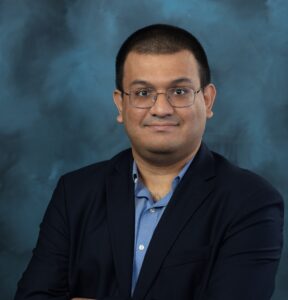
Aneesh Ramaswamy is a Postdoctoral Research Associate in the Quantum Communications and Networking group at Oak Ridge National Laboratory. His research areas include theoretical atomic molecular and optical physics, experimental quantum optics, and quantum networking. He is interested in the theoretical modelling of quantum noise in discrete-variable and continuous-variable systems using phase-space methods, as well as the development of experimental methods for noise compensation and characterization in optical links.
He obtained his PhD in physics at Stevens Institute of Technology in Hoboken, NJ, where he studied quantum control theory with ultrafast processes in atomic systems. He earned his B.S in physics at University of Illinois Urbana-Champaign.
Presentation Title:
Polarization drift characterization of optical signals on deployed fiber links on a quantum network testbed
Presentation Abstract:
Fiber links are an attractive platform for quantum networking with photonic qubits because they leverage existing, mature telecommunications infrastructure. However, optical fiber exhibits time-varying polarization transformations that can significantly degrade state fidelity. These drifts are driven by environmental conditions and often show strong diurnal and weather-related structure. We report a long-term study of low-frequency polarization drift on hybrid aerial–buried fiber links and quantify its environmental dependencies.
We collect power measurements of a classical, polarized, optical signal transmitted over 15 km aerial–in-ground fiber loops in a quantum networking testbed over 11 months. Guided by a rigorous theoretical model, we analyze the sub-Hz spectrum of the drift and use spectral moments as features. We relate these features to temperature, relative humidity, wind speed, and time of day using a correlation analysis and machine-learning regression. We observe pronounced diurnal behavior and seasonal dependencies: the spectral area peaks during daytime, coincident with temperature and wind speed peaks, and humidity dips, with minimal activity at night. Finally, we evaluate random forests for estimating spectral-moment features from environmental measurements. Estimation from nearby weather-station measurements (sampled every two minutes) is only partially successful. This suggests that extensive link-local sensing, higher data coverage, and more complex ML models are required to improve estimation performance.