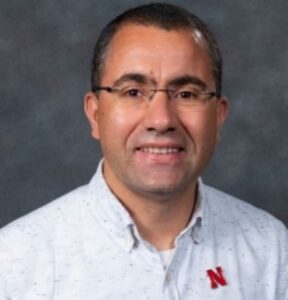
Dr. Laraoui is an Associate Professor of Mechanical and Materials Engineering at the University of Nebraska-Lincoln (UNL). Dr. Laraoui obtained his PhD in Physics from the University of Strasbourg in France, received a Marie Curie fellowship, and held a postdoctoral position at the University of Kaiserslautern, Germany. Dr. Laraoui’s primary research focuses on developing new quantum materials based on color centers in diamond and defects in 2D materials for applications in quantum sensing, nanoscale imaging, and quantum photonics. Dr. Laraoui has published more than 45 papers and has been invited to prestigious conferences, including the 2023 Gordon Conference in Quantum Sensing, the 2023/2026 Annual Conference on Magnetism and Magnetic Materials, SPIE Photonics West 2024, and the 2025 APS Global Physics Summit. Recently, Dr. Laraoui was awarded the NSF EPSCoR fellowship, received the 2025 College of Engineering Edgerton Rising Faculty Award, and was awarded a Leonard A. Lovell Associate Professorship.
Presentation Title:
Probing Spin Dynamics of van der Waals Magnets Using Nitrogen-Vacancy Magnetic Microscopy
Presentation Abstract:
Nitrogen vacancy (NV) magnetic microscopy has become a powerful tool to detect weak magnetic fields with a good spatial resolution (≤ 50 nm), sensitivity (pT-mT/Hz-1/2), and dynamic range (Hz – >20GHz). Here, I discuss recent NV magnetometry results to study spin dynamics of chromium(III) chloride (CrCl3) and 1T-chromium ditelluride (CrTe2) van der Waals (vdW) magnets. CrCl3 exhibits two closely spaced magnetic phase transitions on cooling: paramagnetic-ferromagnetic (TC ~18 K) and ferromagnetic-antiferromagnetic (TN ~14 K). Within the ferromagnetic phase, the amplitude of NV Rabi oscillations collapsed, and spin-lattice relaxation time (T1) is reduced by approximately two orders of magnitudes, indicating a strong spin-wave bath dynamics spanning in the GHz frequency regime. 1T-CrTe2 flakes exhibit room-temperature (TC ~315 K) ferromagnetism, and lower (a few GHz) resonance frequencies and damping (~0.047) compared to bulk crystals. NV T1 is reduced at resonance due to the local spin noise produced by spin waves in CrTe2 flakes.