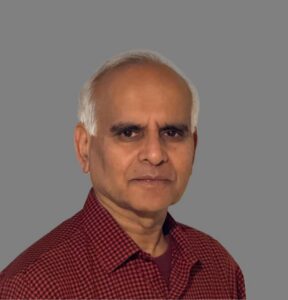
Nagi Rao is currently a Corporate Fellow with the Oak Ridge National Laboratory, where he joined in 1993. His research areas include quantum networking, information fusion, machine learning, and networked science instruments, with more than 500 technical journal and conference papers. He is a Life Fellow of IEEE, a Fellow of International Society for Information Fusion, and received the 2005 IEEE Computer Society Technical Achievement Award and the 2014 R&D100 Award. His quantum networking projects are funded by DOE and DARPA.
Presentation Title:
AI for Quantum Networking: Estimators and Fusers for Fiber Delay Estimation Using Environmental Measurements
Presentation Abstract:
The properties of deployed network fiber are affected by environmental factors due to their exposure to the elements. Particularly for quantum networks, the resultant delay variations may have significant impacts due to the extreme sensitivity of synchronization, coincidence counting, and other critical operations. In this paper, the delays of 15 km aerial-inground fiber connections are measured, and effects due to temperature, humidity and wind speed are analyzed over multiple periods spanning four seasons of a year. Machine learning methods are first utilized to reveal surprisingly pronounced effects of humidity on the delay, in addition to the expected temperature and its seasonal variations. Estimator and fusion methods are developed to estimate the delay using temperature, humidity and wind speed measurements, by utilizing smooth Gaussian Process Regression (GPR) and nonsmooth Ensemble of Trees (EOT) methods. Measurements from winter and summer periods are temporally fused using twelve different methods, and eight methods provide estimates for the delay throughout the year with median test errors under 1.28%. The results reveal distinct temperature-humidity trends across the seasons, and the ability of estimator and temporal fusion methods to exploit them for estimating the delay. These results constitute a case study of machine learning analytical results, wherein generalization equations explain the performance of various estimator and fuser methods.