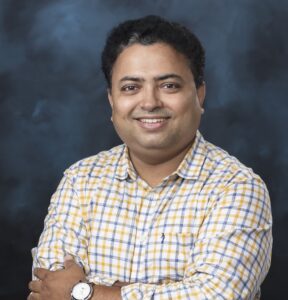
Dr. Tirthankar Ghosal is a Staff Scientist in Artificial Intelligence and Natural Language Processing in the Computer Science and Mathematics Division at Oak Ridge National Laboratory (ORNL). He serves as Project Lead for Agentic Software within the Quantum Science Center’s Software Thrust, where he leads multiple initiatives at the intersection of AI and Quantum Computing. At ORNL, Dr. Ghosal is the Principal Investigator on several projects focused on AI for Laboratory Operations and Scientific Discovery, and he is an investigator on major Department of Energy efforts, including the ASCR SciDAC FORUM-AI and RAPIDS3 programs. His research spans AI for Science, particularly Scientific Hypothesis Generation and Autonomous Laboratories, along with AI for High-Performance Computing, Complex Engineering Diagram Parsing, and Scientific Foundation Models. Dr. Ghosal’s recent recognitions include the 2026 DOE INCITE and NESAP for Doudna awards for his team’s work on AI-driven astrophysical and cosmological simulations, as well as the AI for Science Dataset Award at NeurIPS 2025. His contributions have also been recognized as best paper awards in leading venues such as JCDL and FORCE11. In addition to his role at ORNL, Dr. Ghosal holds an affiliate appointment as a Senior Scientist in Computational Materials Physics at Lawrence Berkeley National Laboratory. He is also an educator, having designed a graduate-level course on Generative AI and Natural Language Processing at the Bredesen Center at the University of Tennessee, Knoxville, where he continues to teach PhD students. Beyond his research, Dr. Ghosal is an active leader in the broader AI community. He has served as Diversity and Inclusion Chair for ACL conferences, organized workshops, shared tasks in Machine Learning and NLP, and contributed to program committees for premier conferences including NeurIPS, ICLR, AAAI, IJCAI, COLM, ACL, etc. and reviewer of top journals like Nature Human Behavior, PLOS ONE, Royal Astronomical Society, Nature Communications, ACM Transactions on Information Science, etc. More information on him can be found at: https://www.tirthankarghosal.com/
Presentation Title:
AI for Quantum at the Quantum Science Center: Towards building a Connective Layer Across the Quantum Computing Stack
Presentation Abstract:
Quantum computing is advancing toward utility faster than the surrounding scientific infrastructure can absorb it. The field confronts a fragmented and rapidly expanding literature, the combinatorial intractability of fault-tolerant error correction, the absence of principled evaluation standards for AI systems operating in the quantum domain, and the formidable orchestration burden of coupling nascent quantum processors with mature high-performance computing (HPC). This talk presents the AI for Quantum efforts of the Agentic Software team at the Quantum Science Center (QSC), Oak Ridge National Laboratory, advancing a unifying thesis: that artificial intelligence can serve as the connective and accelerating substrate of the quantum stack, spanning knowledge curation, scientific reasoning, and HPC-integrated execution. We present a complementary portfolio of seven efforts organized along three axes. For knowledge infrastructure, we describe Quantum RAG, a retrieval-augmented generation system grounded in domain-specific corpora, and the Quantum Computing LLMWiki, a curated, machine-readable knowledge resource. For evaluation, we introduce the Quantum Computing Leaderboard, which rigorously benchmarks frontier AI models on quantum code generation, alongside benchmark development for the IEEE Quantum Week (QCE) shared-task problems. For domain reasoning and systems, we present preliminary versions of ChatQEC and FTQEC, language-model-driven assistants for quantum and fault-tolerant error correction, and a quantum computing multi-agent framework that decomposes complex quantum-HPC workflows across specialized agents and currently demonstrates strong code generation performance. We further introduce EPIC, a multi-agent framework for HPC orchestration, data management, and predictive analytics that we are extending toward quantum-HPC (QHPC) co-execution. Throughout, we report design rationale, quantitative findings where available, and the characteristic failure modes that frontier models exhibit on rigorous quantum tasks. We conclude by articulating how these components compose into an integrated assistance and evaluation fabric for the quantum community, and by framing the open problems that must be solved to realize trustworthy, verifiable AI for quantum science.