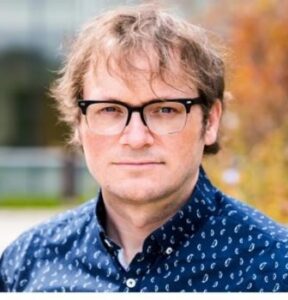
Joe received his bachelor’s degree in Computer Engineering and Music Theory from the University of Michigan, and his Ph.D. in electrical engineering from the University of California, Santa Barbara, where he worked in the group of David Awschalom researching spin defects in wide-bandgap materials. He then joined the University of Chicago as a postdoc, before starting as an assistant staff scientist at Argonne National Lab in 2016. He is currently a staff scientist at Argonne National Laboratory in the Materials Science Division, and a CASE Affiliated Scientist at the University of Chicago, Pritzker School of Molecular Engineering. At Argonne, Joe co-leads the QIS group in the Materials Science Division and serves as the lead for the Argonne Quantum Foundry, a Q-NEXT facility focused on full stack materials development of solid-state qubit systems.
Presentation Title:
Materials co-design for scalable solid-state quantum technologies
Presentation Abstract:
Defect-based qubits in solid-state hosts have been extensively studied for a wide range of quantum applications including quantum information processing, sensing, and communication. As these systems transition from proof-of-concept demonstrations toward viable quantum technologies, new integration and material challenges have emerged. Here, I will present several approaches focused on addressing these integration challenges in combining spin qubits within quantum relevant material hosts (e.g. diamond, silicon carbide) along with developing the simulation toolkits needed to efficiently model the necessary defect creation and interaction physics. This will include work on utilizing scalable materials synthesis, advances in spin-qubit defect creation, development of membrane fabrication, device integration, and fabrication approaches towards developing hybrid interfaces between material platforms. I also touch upon experimentally validated computational efforts that build up toolkits to help explore new solid-state systems for quantum sensing applications. Collectively these topics aim to highlight the challenges and co-design opportunities in integrating spin-qubits, solid-state systems, and devices for scalable quantum sensing.