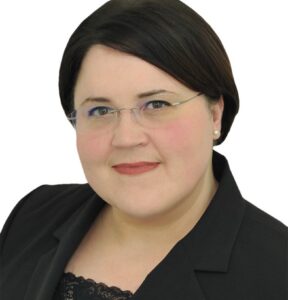
Laura Schulz is Quantum Innovation Lead at the Argonne Leadership Computing Facility (ALCF), where she leads the integration of quantum computing into HPC and AI infrastructure for scientific computing. Before joining Argonne, she held a leading role at Munich Quantum Valley (MQV), serving as Head of the Quantum Computing and Technologies Department at the Leibniz Supercomputing Centre (LRZ) and as Principal Investigator for EuroHPC’s Euro-Q-Exa project. In these roles, she helped shape quantum–HPC integration across European infrastructure, procurement, and software initiatives. Her work spans system software, orchestration, and end-to-end HPC–AI–quantum workflows, with a focus on making quantum computing a practical, scalable component of advanced computing environments.
Presentation Title:
The Missing Middle of Quantum Supercomputing: From Fault-Tolerant Hardware to a Managed Scientific Resource
Presentation Abstract:
Fault-tolerant quantum computers will not become scientific resources through hardware performance alone. Their impact depends on integration into the broader ecosystem of advanced computing, where quantum, HPC, and AI solve scientific problems together. Between logical operations and scientific discovery lies a “missing middle” of control, orchestration, software, and facility operations. The challenge is not only achieving fault tolerance, but building the systems that make quantum hardware a trusted component of scientific computing infrastructure.
This talk examines practical systems questions arising as fault-tolerant quantum processors become part of a leadership-class computing ecosystem, including real-time control, error correction, runtime, workflow orchestration, portable interfaces, hybrid workload management, and operational use of telemetry, calibration, and uncertainty. It also explores the definition of user. There is no single homogenous user community. Domain scientists, algorithm developers, compiler and QEC experts, AI and HPC practitioners, and facility operators require distinct abstractions, shaping software architecture, operations, security, and service models for trustworthy scientific resources.