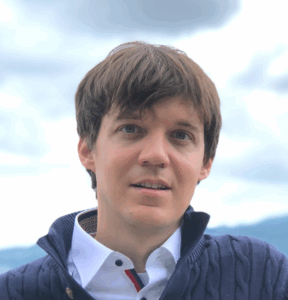
Peter Maurer is an Assistant Professor at the Pritzker School of Molecular Engineering at the University of Chicago and an Investigator at the Chan Zuckerberg Biohub Chicago. He received his PhD from Harvard University with Mikhail Lukin, where he developed diamond nano-thermometers to measure temperature profiles in living cells. Motivated by the vision of using quantum sensors to probe biology, he pursued postdoctoral training with Steven Chu at Stanford, designing luminescent nanoprobes for electron microscopy. At UChicago, Peter’s group integrates quantum engineering, biophysics, and materials science to create biocompatible quantum sensors. His team has pioneered the first optically addressable spin qubit encoded in a fluorescent protein, engineered nanodiamonds for intracellular chemical mapping, and multiplexed diamond arrays for molecular detection. They are also advancing a 14-Tesla NV-enabled μ-NMR platform with parts-per-billion resolution for femtoliter-scale structural analysis, bridging quantum information science with transformative applications in the life sciences.
Presentation Title:
From diamond defects to protein-based qubit sensors
Presentation Abstract:
Quantum metrology enables some of the world’s most sensitive measurements, with transformative potential for the life sciences. Yet, applying qubit sensors to monitor cellular processes or detect disease remains a challenge. This talk will present strategies that merge quantum engineering with molecular biology to develop biocompatible quantum sensors. I will first describe a new surface functionalization method for highly coherent diamond crystals, followed by an approach to engineer spin coherence in core–shell diamond particles that can be chemically modified and delivered to cells. Finally, I will introduce a new class of biological qubits: optically addressable spins in fluorescent proteins. These genetically encodable, 3 nm protein-qubits achieve coherence times and optical readout comparable to solid-state defects. Together, these advances highlight the convergence of quantum engineering and biology and point toward practical sensing platforms for probing fundamental processes and disease in living systems.