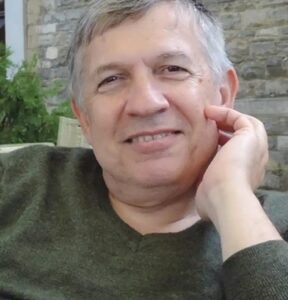
Dr. George Siopsis is a Professor of Physics at the University of Tennessee and a leading researcher in quantum computing and quantum information science. He holds a Ph.D. in Physics, specializing in theoretical high-energy physics, from the California Institute of Technology (Caltech). His research spans quantum algorithms, quantum simulation, and quantum machine learning, with applications implemented on diverse quantum hardware platforms, including superconducting qubits (IBM Q), trapped-ion systems (IonQ, Quantinuum), and neutral atom arrays (QuEra).
Dr. Siopsis also established a quantum optics laboratory in partnership with Oak Ridge National Laboratory to advance quantum communications and cryptography. His work is supported by the Department of Energy, National Science Foundation, DARPA, and other federal agencies. He is actively engaged in quantum workforce development and cross-sector collaborations to accelerate the transition from foundational research to scalable quantum technologies.
Presentation Title:
Towards Quantum Advantage in Gauge Theories
Presentation Abstract:
Gauge theories underpin our understanding of fundamental interactions, yet their nonperturbative regimes—particularly real-time and finite-density dynamics—remain computationally intractable on classical platforms due to the exponential scaling and sign problem of lattice methods. In this talk, I will present a quantum computing framework for simulating quantum fields and gauge theories using continuous-variable (CV) architectures, where information is encoded in photonic qumodes rather than discrete qubits. This approach offers a natural representation of bosonic gauge fields, avoids truncation of continuous symmetries, and enables efficient implementations of Hamiltonian evolution and Wilson loop operators. I will discuss algorithms for lattice gauge theories, ansätze for energy spectra, and prospects for hybrid CV/DV (bosonic/fermionic) simulations.