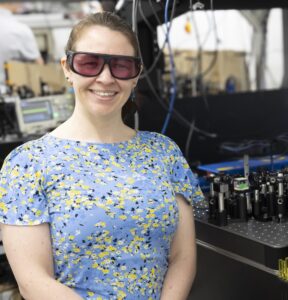
Claire Marvinney is an early career staff scientist at Oak Ridge National Laboratory in the Quantum Information Science Section. Currently, Claire’s research focuses on quantum optical sources of light for continuous-variable quantum sensing and transduction experiments, developing resources with reduced measurement added noise. She currently leads a new ORNL LDRD project for this work. Claire is also one of the managers of the Quantum Computing User Program, leading the Quantum Resource Utilization Council. Through this work, Claire also helps administer quantum computing resources at ORNL. Claire first joined ORNL in 2018 as an Intelligence Community Postdoctoral Fellow, where she worked on the development of a millikelvin optical microscopy system to study quantum materials at cryogenic temperatures. Her PhD is in Interdisciplinary Materials Science from Vanderbilt University. Outside of her work, Claire conducts science outreach in the local community, teaching quantum information through demonstrations and science games.
Presentation Title:
Quantum Sensing with Squeezed Light
Presentation Abstract:
Quantum sensing allows for the estimation of a parameter with an enhanced sensitivity beyond the classical limit. Quantum optical sensors, in particular, harness quantum properties of light, such as squeezing and entanglement. We leverage these quantum properties for two sensing applications: characterization of quantum-materials and high-energy physics searches for novel particles, such as dark matter. Towards the first application, we show a 3 dB noise reduction in magnetic circular dichroism measurements, a characterization technique that can be used to study frustrated magnetic materials such as quantum spin liquids. For the second, we show a 1.7 dB enhancement in the estimation of the average of two phases in a distributed quantum sensing configuration, and lay the groundwork for determining sensitivity limits for impulsive detection with optomechanical systems with a focus on ultra-heavy dark matter detection. Cryogenic capabilities, now available in our lab, will enable improved measurement conditions for future quantum-sensing experiments.