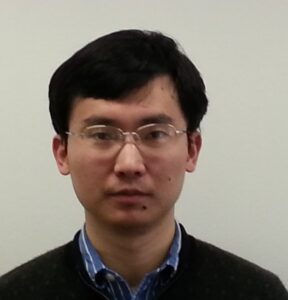
Kai Sun is a Physics Professor at the University of Michigan, an APS Fellow, and a Sloan Research Fellow. His research focuses on quantum materials, topological phases, moiré systems, and strongly correlated phenomena, with an emphasis on connecting theoretical advances to experimental realizations. His current work explores how flat bands, topology, and strong interactions give rise to novel states of matter with potential applications in quantum computing.
Presentation Title:
Robust Fractional Topological States Beyond Landau Levels: Flat Chern Bands as a Pathway Toward More Robust Topological Qubits
Presentation Abstract:
A central challenge in quantum computing is to build systems that are both scalable and intrinsically resilient to noise and decoherence. Topological quantum computing offers a promising route: by encoding information in topologically protected states, qubits can remain stable against virtually all forms of disturbance. Among the most compelling candidates are fractionalized topological phases, where excitations carry fractional charge and obey exotic statistics, providing a natural foundation for fault-tolerant computation. Traditionally, such states require Landau levels and strong magnetic fields. Recent advances in flat Chern bands engineered in moiré superlattices and other two-dimensional materials have opened new opportunities to stabilize fractional topological states without the need for large external fields. In this talk, I will compare fractional states in flat Chern bands with the well-established fractional quantum Hall states, highlighting both their shared principles and their distinct features. I will discuss how flat-band platforms may offer enhanced robustness, potentially enabling topological qubits that operate at higher temperatures—an important step toward practical quantum computing.