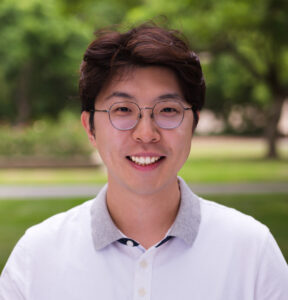
Joonhee Choi is an Assistant Professor of Electrical Engineering at Stanford University. He received his Ph.D. and master’s degrees from Harvard University and his bachelor’s degree from KAIST. Prior to joining Stanford, he was an IQIM postdoctoral fellow at Caltech. Joonhee’s research focuses on engineering the dynamics of quantum many-body systems to explore fundamental science and to demonstrate practical quantum applications in metrology, communication, and information processing. Throughout his career, he has worked across a wide range of fields, including ultrafast and nano-optics, solid-state and atomic physics, and quantum many-body physics. He is the recipient of the Outstanding Young Researcher Award from AKPA (2021), the KSEA Young Investigator Grant (2024), the AFOSR Young Investigator Program (YIP) Award (2025), the Google Research Scholar Program Award (2025), the DOE Early Career Research Program Award (2025), and the Terman Faculty Fellowship in the School of Engineering at Stanford.
Presentation Title:
Quantum Sensing With a Spin Ensemble in a Two-Dimensional Material
Presentation Abstract:
Quantum sensing with solid-state spin defects has transformed nanoscale metrology, offering sub-wavelength spatial resolution with exceptional sensitivity to multiple signal types. Maximizing these advantages requires minimizing both the sensor-target separation and detectable signal threshold. However, leading platforms such as nitrogen-vacancy centers in diamond suffer performance degradation near surfaces or in nanoscale volumes, motivating the search for optically addressable spin sensors in atomically thin, 2D materials. Here, we present an experimental framework to probe a novel 2D spin ensemble, including its Hamiltonian, coherent sensing dynamics, and noise environment. We achieve a record coherence time of 80 μs and nanotesla-level AC magnetic sensitivity at a 10 nm target distance, reaching the threshold for detecting a single nuclear spin in nanoscale spectroscopy. Leveraging the broad opportunities for defect engineering in atomically thin hosts, these results lay the foundation for next-generation quantum sensors with ultrahigh sensitivity, tunable noise selectivity, and versatile quantum functionalities.