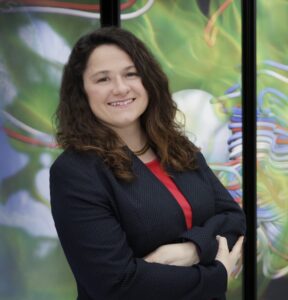
Suzanne Parete-Koon leads workforce development efforts in high-performance computing, artificial intelligence, and quantum computing for the Computing and Computational Sciences Directorate at Oak Ridge National Laboratory, with a focus on helping students and staff build the skills needed to use emerging computing technologies in scientific research. Her work spans training and curriculum development, mentoring and internship programs, and partnerships across national laboratories, universities, government, and industry. She has a Ph.D. in astrophysics from the University of Tennessee and a background in computational science, including computational astrophysics, leadership-class computing, and scientific user support. Before moving into workforce development, she held technical and leadership roles supporting ORNL computing and research communities and served as a U.S. Department of State Foreign Affairs Officer through an American Institute of Physics fellowship.
Co-Presenting with Chris Beatty, ORNL
Presentation Title:
Workforce Development in the Era of HPC/AI and Quantum Computing Convergence
Presentation Abstract:
As HPC, AI, and quantum computing increasingly converge in scientific workflows, our workforce development approaches need to converge as well. Staff do not necessarily need to become experts in every technology, but they do need opportunities to build enough knowledge across disciplines to recognize where new approaches can advance their work. This talk will discuss ORNL efforts to strengthen internal and external connections through strategic regional engagement with university faculty and academic leaders, particularly at institutions with research and educational strengths aligned with DOE priorities such as the Genesis Mission, AI, HPC, quantum information science, nuclear engineering, and other critical and emerging technologies. It will also highlight cross-skilling approaches that allow staff to apply what they are learning directly to their own research, projects, and scientific challenges through hands-on exercises, mentoring, clinics, and focused learning sprints. Finally, the talk will highlight opportunities such as the DOE Office of Science Graduate Student Research (SCGSR) program, which enables university students and faculty to partner directly with national laboratory researchers on thesis research aligned with DOE priorities. Together, these efforts provide complementary approaches to building the multidisciplinary workforce needed for the next generation of scientific computing and discovery.