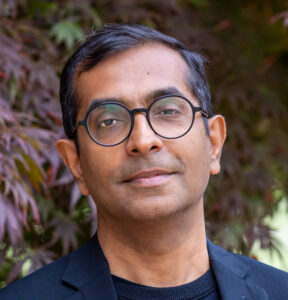
Shantenu is the head of computational sciences at the DOE’s Princeton Lab and a professor of computer engineering at Rutgers University-New Brunswick. His primary research lies at the intersection of AI for Science, high-performance computing, and computational and data science. His research is driven by the modest goal of achieving a ten orders-of-magnitude increase in scientific performance within the next decade. He has received the ACM Gordon Bell Special Award (2020), numerous other supercomputing awards, the IEEE SCALE 2018, and the NSF CAREER Award (2013).
Presentation Title:
Doppleganger: Building Block Components and Services for Building Digital Twins
Presentation Abstract:
Modern scientific digital twins must integrate streaming observations, heterogeneous AI models, physics-based simulations, and distributed computing resources while maintaining low-latency, resilient operation. This talk presents Doppleganger, a collection of composable components and platform services for building adaptive digital twins on the Genesis Mission Platform. Doppleganger adopts a capability-centric architecture in which digital twins are composed as reusable graphs of sensing, simulation, inference, learning, and decision-making components. The framework provides common services for streaming data ingestion, persistent workflow artifacts, asynchronous orchestration, capability-based composition, cross-model learning, and deployment across the edge–cloud–HPC continuum, enabling developers to build complex digital twins independent of specific model architectures or execution environments. A key service, Reverse Backfill (RBF), decouples continuous edge inference from computationally intensive simulation and surrogate model generation by treating HPC as an opportunistic model-improvement engine. Using persistent workflow artifacts, asynchronous coordination, and decision-time scheduling, RBF continuously refreshes deployed models while improving the efficiency of shared HPC resources. We will demonstrate these capabilities through a digital agriculture application that integrates edge sensing, computational fluid dynamics, and multiple surrogate learning models across edge, dedicated cluster, and HPC resources, showing how Doppleganger enables scalable, adaptive, and resilient scientific digital twins.