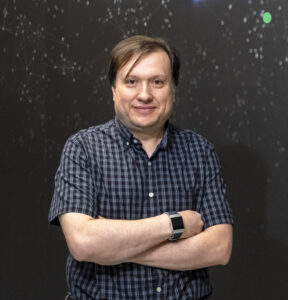
Oscar Hernandez is a senior computer scientist in the Advanced Computing Systems Research Section at Oak Ridge National Laboratory. His research focuses on high-performance computing, energy-efficient system design, programming models, communication middleware, performance analysis, and AI-assisted software development.
He leads and contributes to projects spanning exascale computing, OpenSHMEM, hardware/software co-design, power and thermal observability, and next-generation data center architectures. His recent work investigates end-to-end energy measurement and optimization across leadership-class supercomputers, integrating facility, hardware, runtime, and application-level telemetry to improve scientific productivity and energy efficiency. Hernandez actively collaborates with national laboratories, universities, and industry partners on technologies that enable future HPC and AI systems.
Presentation Title:
Following the Watt: End-to-End Energy Observability for AI and Exascale Computing
Presentation Abstract:
The rapid growth of artificial intelligence and exascale computing is transforming energy into a first-class design constraint. Future systems will not be limited solely by performance, but also by power delivery, cooling capacity, thermal management, and the ability to convert electrical energy into useful scientific work. Addressing these challenges requires more than facility-level metrics, it requires the ability to observe and understand how energy is transformed across the entire computing stack.
We begin by following the watt. From the moment electrical energy enters a modern supercomputer, it travels through a hierarchy of power delivery systems, cooling groups, cabinets, nodes, accelerators, networks, runtimes, and applications before ultimately leaving the system as heat. Understanding this journey is an observability challenge that spans both the computing stack and the facility infrastructure. By tracing energy from scientific applications and AI workloads down to hardware components and up through cooling and thermal systems, we can expose hidden inefficiencies, quantify where energy is transformed into useful work, and identify optimization opportunities that only emerge when the system is viewed as a whole. This perspective motivates a new generation of energy-aware tools, digital twins, and optimization techniques designed to make sure that every watt contributes as effectively as possible to scientific discovery.