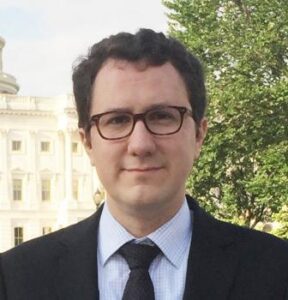
Nicholas Schwarz is a Principal Computer Scientist at Argonne National Laboratory, where he leads strategy and programs at the intersection of artificial intelligence, data, and large-scale scientific computing at the Advanced Photon Source. His work focuses on integrating advanced computing capabilities with experimental and observational facilities to enable new modes of scientific discovery.
He leads the APS scientific computing strategy across AI and machine learning, data systems, scientific software, high-performance computing, and facility-scale infrastructure. In this role, he coordinates efforts across groups, divisions, and directorates to address growing data volumes and enable real-time analysis, adaptive experimentation, and AI-driven scientific workflows.
Nicholas also chairs cross-facility committees spanning U.S. Department of Energy light and neutron sources and leads laboratory-wide initiatives connecting experimental facilities with leadership-class supercomputing resources.
Presentation Title:
Enabling Next-Generation AI-Driven Discovery at the Scientific User Facilities with the American Science Cloud
Presentation Abstract:
DOE scientific user facilities generate increasingly large and complex data streams and require AI-enabled analysis, advanced computing, and experiment-in-the-loop feedback on operational timescales. The Scientific User Facility Infrastructure Partnership project brings seven national laboratories together to connect these facilities with the Genesis Mission’s American Science Cloud platform. This talk will describe the partnership’s co-design and integration approach, spanning common identity, data movement and discovery, model and inference services, and access to large-scale computing. Representative demonstrators address agentic accelerator control, cross-facility nuclear physics workflows, scalable inference for high-energy and nuclear physics, light and neutron source analysis, and cosmology. Together, they provide realistic requirements and reusable patterns for an interoperable AI and computing fabric across DOE facilities. The talk will highlight early results, lessons from multi-facility integration, and the path from prototypes to operational capabilities that reduce time to science and enable new modes of AI-driven discovery.