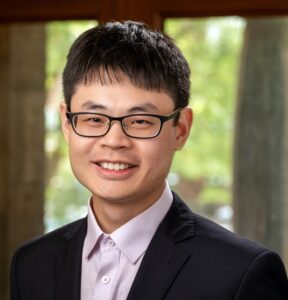
Lu Lu is an Assistant Professor in Departments of Statistics and Data Science and of Chemical and Environmental Engineering at Yale University. Prior to joining Yale, he was an Assistant Professor in Department of Chemical and Biomolecular Engineering at University of Pennsylvania from 2021 to 2023, and an Applied Mathematics Instructor in Department of Mathematics at MIT from 2020 to 2021. He obtained his Ph.D. degree in Applied Mathematics at Brown University in 2020, master’s degrees in Engineering, Applied Mathematics, and Computer Science at Brown University, and bachelor’s degrees at Tsinghua University in 2013. His current research interest lies in scientific machine learning and artificial intelligence for science, including theory, algorithms, software, and its applications to engineering, physical, and biological problems. He has received the MIT Technology Review Innovators under 35 Asia Pacific, DOE Early Career Award, Mathematics Young Investigator Award from MDPI, and Joukowsky Family Foundation Outstanding Dissertation Award.
Presentation Title:
Foundation Neural Operators and Diffusion Models Over Function Spaces
Presentation Abstract:
Deep neural operators have emerged as a powerful paradigm in scientific machine learning for learning nonlinear mappings between function spaces arising in complex dynamical systems. In this talk, I will introduce the deep operator network (DeepONet) and its extensions, such as geometry-dependent/manifold operator learning, and demonstrate their effectiveness on diverse multiphysics and multiscale 3D problems, such as fire simulation and topology optimization. I will then present the first operator learning method requiring only a single PDE solution, i.e., one-shot learning, enabled by a new concept of local solution operator motivated by the locality of physics. Moreover, I will discuss our recent work on diffusion models, including FunDiff as a novel framework of diffusion models over function spaces for physics-informed generative modeling. Finally, I will present a physics-informed multimodal foundation model for PDEs and neural-operator element method (an efficient and scalable finite element method enabled by reusable neural operators).