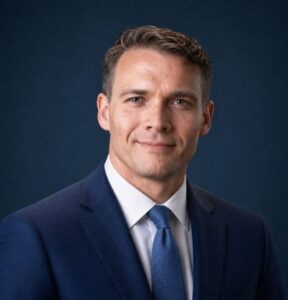
Aaron is a Sr. Principal Technical Product & Program manager in HPE Quantum as part of the Emergent Machine Intelligence team at HPE Labs. Aaron is also an Adjunct Associate Professor at University of Maryland, College Park in the institute for Physical Science and Technology (IPST).
Prior to joining HPE, Aaron was a Sr. Scientist & Technical Program Manager in the NASA Ames Quantum Artificial Intelligence Laboratory (QuAIL) leading R&D in the contractor teams across quantum computing, machine learning, data science and nanodevices. Aaron also served as Director of Technical Product Management at D-Wave, where he led development of the D-Wave 2X, D-Wave 2000Q hardware and software features, open-source software, as well as several research projects exploring algorithms, benchmarking, and development of quantum computers in optimization, machine learning and materials science applications.
Aaron performed post-doctoral research at the National Institute of Standards and Technology and Lawrence Livermore National Laboratory. Aaron earned his Ph.D. in Applied Mathematics and Scientific Computation at the University of Maryland.
His current interests are in building a quantum supercomputer, via deep integration between classical high-performance computing, multiple quantum hardware modalities and AI techniques to enable the next generation of scientific computing.
Diamond Sponsor Presentation: Co-Presenting with Robert Wisniewski
Presentation Title:
Embracing Heterogeneity
Presentation Abstract:
With the ending of Moore’s Law and Denard Scaling there has been an increasing number of accelerators being developed. Coupled with the explosion of AI this has led to a divergent need and opportunity for focused technologies to provide an advantage as part of the overall workflow solution. Examples include AI accelerators targeted for inference, quantum computing. And with the advent of agentic computing CPUS are playing a critical role in the overall system. In this talk, we will focus on a system architecture that can incorporate these technologies, and we will provide a description of how Quantum Computing fits into this macroheterogeneous world. We will describe a way to reason and propose a way to evaluate macroheterogeneity, and we will describe an architecture for Quantum Computing and the value of coupling it to HPC and AI. The most productive future is not HPC, AI, or Quantum Computing but a combination of all three.