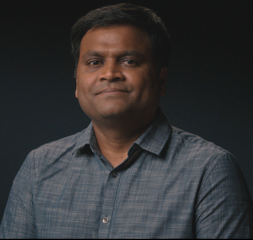
Dr. Seetharami R. Seelam is a Distinguished Engineer at IBM and a leader in large-scale systems architecture spanning hybrid cloud, high-performance computing (HPC), AI, and quantum computing. He currently serves as Chief Architect of Classical System Co-Design for Quantum-Centric Supercomputing (QCSC), where he applies deep systems expertise to accelerate and scale classical components of quantum algorithms. His work focuses on demonstrating quantum advantage by advancing classical subroutines of QCSC algorithms, developing integrated GPU-based solutions for outer decoders, and defining reference system architectures that unify quantum, HPC, and AI with an eye toward the scaling requirements of Starling and Blue Jay systems. He also leads collaborative efforts with partners and national laboratories on next-generation HPC and quantum architectures.
Diamond Sponsor Speaker
Presentation Title:
An update on Quantum-Centric Supercomputing
Presentation Abstract:
How will quantum computers and HPC systems work together? Must they be co-located and tightly coupled, or can geographically distributed systems still enable workloads to leverage the unique capabilities of each platform? What scheduling and resource management challenges emerge when quantum systems become part of HPC datacenters and are integrated into HPC workflows? These are questions we at IBM have been addressing in a recent paper proposing a reference architecture for a Quantum-Centric Supercomputer.
In this talk, we present a nuanced view — grounded in workload requirements and technology maturity — of how quantum and HPC systems will work together across near- and long-term timescales. We propose a co-designed strategy spanning quantum and classical HPC infrastructure, middleware, and application layers to accelerate quantum adoption for critical computational problems. We frame this Quantum-Centric Supercomputing (QCSC) evolution in three phases: (1) quantum systems as specialized compute offload engines within existing HPC complexes; (2) heterogeneous quantum-classical systems coupled through advanced middleware, enabling seamless hybrid algorithm execution; and (3) fully co-designed quantum- HPC systems purpose-built for hybrid computational workflows. We conclude with a reference architecture, roadmap and an update on realizing each of these phases.