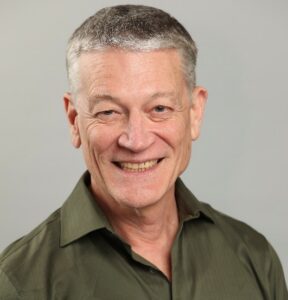
Bob Ciotti is the Chief Architect in HPC & AI at CTG Federal. Prior to CTG Federal, Ciotti spent 37 years at NASA’s lead center for supercomputing, Ames Research Center in Mountain View, CA. Various roles included Chief Architect and Lead for Supercomputing Systems, and Chief Technology Officer in NASA’s Advanced Supercomputing Division (NAS). There, he developed operational environments for numerous supercomputing systems including vector, massively parallel, large coherent shared memory, and large scale clusters. The most notable being Columbia #2 and Pleiades #3 on the Top 500 list of the worlds fastest supercomputers, each operating 24x7x365 for years in support of the Agencies mission critical supercomputing needs. Recently in collaboration with JPL, Ciotti developed prototypes for distributed computing environments that span commercial cloud and on-prem systems. These ‘hybrid’ systems are bespoke designs that may be used on future earth observing satellite missions and beyond.
Diamond Sponsor Presentation
Presentation Title:
Bridging the Gap: Evolving U.S. Government Supercomputing Strategies in the Hyperscaler Era
Presentation Abstract:
Over the past four decades, government-led supercomputing pioneered innovations from early vector machines through massively parallel processors, the largest SMPs, Beowulf clusters, and onto accelerator-based designs that enabled the largest exa-scale systems ever built. These efforts demonstrated the capability of public institutions to push technological boundaries with their industrial partners.
However, in the last decade, the landscape has shifted dramatically. The commercial hyperscale industry is reshaping high-performance computing and investing at unprecedented scales, vertically integrating designs, and creating cloud-native architectures that dominate AI, machine learning, and large-scale data analytics. This shift has left the government increasingly marginalized and dependent on commercial cloud solutions and ultimately lacking access to some of the most advanced technologies needed to develop and manage similar environments for itself.
This talk examines the evolution of supercomputing as viewed by the speaker when working at NASA alongside the rise of hyperscalers, identifies the structural and strategic differences between these two worlds, and proposes a potential path forward.