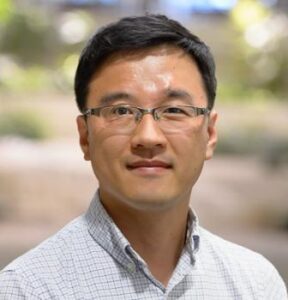
Kibaek Kim is a [Computational Mathematician] in the Mathematics and Computer Science Division at Argonne National Laboratory. His research develops scalable algorithms at the intersection of large-scale optimization, machine learning, and high-performance computing — spanning foundation-model pretraining, agentic AI workflows, distributed and federated learning, stochastic programming, and physics-informed methods that exploit leadership-class systems such as Aurora and Frontier. He led Argonne’s effort on the DOE Genesis Mission GridAI seed project, where these methods are advanced through LUMINA, a foundation-model family trained at scale on DOE supercomputers, and GridMind, an agentic analysis workflow. He also leads APPFL, an open-source framework for privacy-preserving federated learning and serves as PI on multiple DOE-funded efforts bridging applied mathematics, AI, and HPC. His work emphasizes algorithms and software that translate frontier compute into deployable scientific and engineering decision support.
Presentation Title:
GridAI: Foundation Models and Agentic AI for the Nation’s Power Grid
Presentation Abstract:
Power grid is among the most consequential and computationally demanding scientific-computing challenges facing the nation, requiring millions of nonlinear optimizations to keep electricity reliable, affordable, and secure. Under the DOE Genesis Mission, the GridAI project is building an AI operating layer for the grid that unites foundation models, agentic reasoning, and DOE leadership computing. LUMINA, a family of graph foundation models for power grid operations, is pretrained at scale on Aurora and Frontier and learns grid physics to deliver solutions orders of magnitude faster than classical solvers. GridMind wraps these models in an agentic workflow that answers operator questions in natural language. I will share our results and lessons from training at scale.