Presented by:
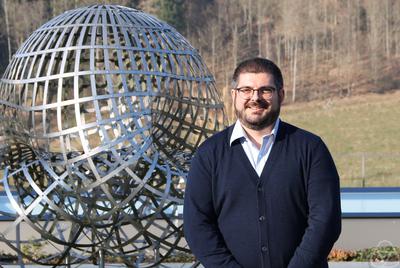
Dr. Patrick Diehl
Los Alamos National Laboratory
Hosted by:
Mathematics in Computation Seminar Series
Thursday | October 22, 2026 | 3:00 – 4:00 p.m.
Abstract:
Scientific advances increasingly depend on close collaboration between domain scientists and computer scientists. This talk illustrates the importance of interdisciplinary research at national laboratories and universities through three applications spanning astrophysics, medical physics, and quantum computing. Although these fields address very different scientific questions, they share common computational challenges, including performance portability, massive parallelism, multiphysics modeling, and scalability on emerging computing architectures.
The first example presents Octo-Tiger, a code for simulating stellar mergers that combines the Kokkos performance-portability ecosystem with High Performance ParalleX (HPX), a C++ library for parallelism and concurrency. Scaling studies performed on U.S. Department of Energy (DOE) computing systems and Japan’s Fugaku supercomputer through a DOE–MEXT collaboration will be discussed. This work demonstrates how computational methods developed for astrophysics can also contribute to advances in aerospace and space applications.
The second example focuses on medical physics, a field with a direct and significant societal impact: approximately 2.1 million people in the United States are diagnosed with cancer each year. A whole-body blood-flow simulation that models the human vascular network, together with a peridynamic model for simulating blood-vessel rupture, will be presented.
Finally, as quantum computing moves toward utility-scale systems, software for large-scale tensor-network contractions and density matrix renormalization group calculations, implemented in Julia using Julia for accelerators for performance-portable computing, will be introduced. Together, these examples demonstrate how interdisciplinary teams can translate domain-specific scientific challenges into broadly applicable algorithms, programming models, and software technologies, and why such collaborations are essential for advancing science.
Speaker’s Bio:
Dr. Patrick Diehl is a research scientist in the Theoretical Division at Los Alamos National Laboratory and an adjunct faculty member in the Department of Physics and Astronomy at Louisiana State University. His research lies at the intersection of high-performance computing, scientific software, and interdisciplinary computational science. He focuses on asynchronous many-task systems, performance-portable programming, modern C++, Julia, and scalable numerical methods for emerging computing architectures. His work applies these technologies to problems in astrophysics, computational mechanics, medical physics, and quantum computing. Patrick serves as an editor for the Journal of Open Source Software and is a coauthor of the Springer textbook Parallel C++: Efficient and Scalable High-Performance Parallel Programming Using HPX. He is also actively involved in high-performance computer training and education. Patrick earned his diploma in computer science from the University of Stuttgart and his Ph.D. in applied mathematics from the University of Bonn.
Host: Pablo Seleson, [email protected], 865-323-2859. Please contact host to meet with the speaker.