
Second Workshop on Enabling Predictive Science with Optimization and Uncertainty Quantification in HPC
Submissions: All paper submissions favored through the reviewing process will be included as part of the SC24 workshop proceedings volume. An 6-page limit will be imposed for submissions including figures, tables, and appendices, but does not include references, for which there will be no page limit.
The peer-review process of all submitted papers will include 2-3 experts in the field, drawn from a growing pool of experts curated since last year’s founding workshop. The evaluation criteria include relevance to the workshop thrusts, impact of the methods used and reproducibility of results. We would like to encourage authors to include placeholders pointing to material (code, results, etc.) with reproducibility information.
How to submit your paper:
SC24 has a submission and registration section partway
You can have access to content and information of the 2023 EPSOUQ-HPC workshop, as part of the SC23, here:
| Date | Activities |
| April 2024 | · Register workshop with a conference submission · Deploy the updated workshop website · Program committee members · Distribute workshop call for papers · Select invited speaker-panelists |
| 01 May 2024 | · Begin collecting submissions |
| 23 Aug 2024 | · Paper submission deadline– Closed |
| 14 Sep 2024 | · Author notification |
| 27 Sep 2024 | · Camera ready copy due/ Video upload for remote presentations |
| Oct 2024 | · Send workshop presentation instructions to authors |
Thrust 1 – Methods driven:
Uncertainty quantification theory and algorithms play a pivotal role in reducing the impact of uncertainties during both optimization and decision-making processes. Bayesian approximation and ensemble learning techniques are among the most used UQ methods. We are looking to extend this notion to include in the workshop work from researchers representing a variety of UQ methods, focusing perhaps on examining performance with a view to general applicability in a wide variety of applications, such as those mentioned in the application section, as well as e.g. computer vision, image processing, medical image analysis, natural language processing, bioinformatics, etc.
Thrust 2-Model/Data driven:
With the advent of the Exascale era we expect to see more of these existing uncertainty propagation methodologies embedded within or wrapped around deterministic simulation codes. For example, sampling-based methods repeatedly call a deterministic simulation code for different values of the model inputs. The independent instantiations of this method makes it a good fit for parallel programming paradigms and deployment to compute nodes in different HPC systems. However, it is unlikely an Exascale computer will provide enough concurrency for a thousand-fold increase in sample evaluations for uncertainty propagation applied in this manner. A key topic in multi-scale simulations is the handling of uncertainty in coupled codes where two or more separate codes work together. Coupled codes could typically include particle-based and continuum (PDE) based models to bridge scales. This thrust will also include methods and applications that can bring together AI/ML and physics-based methods to enable UQ and optimization. Example topics in this area may include in-situ surrogate construction, intrusive reduced order modeling, feature/manifold learning in large data sets.
Thrust 3 – Use-inspired HPC challenges and solutions:
Of particular interest are real-world experiences with HPC systems and articulations of active challenges in the use of these systems for optimization and UQ. Potential topic areas motivated by the desire to perform optimization and UQ include strategies for overcoming supercomputing bottlenecks such as the impact of queue policies and restrictions on scientific workflows, limitations with I/O and methods for I/O coupling when using multiple distinct simulation/analysis tools, in-memory and file-based coupling strategies, mixed-language and mixed-precision computing, and general memory/compute limitations. For the submissions we are not only interested in success stories, as there is incredible value in communicating lessons-learned when a particular idea didn’t come to fruition due to software or hardware limitations.
Agenda 2024
| Welcome and Introduction | Georgiadou, Casey | 20 min. 9am-9:20am |
| A Scalable Training-Free Diffusion Model for Uncertainty Quantification | Rafid, Yin, Geng, Liang, Bao, Ju, Zhang | 20 min. 9:20am-9:40am |
| Ensemble Simulations on Leadership Computing Systems | Georgiadou, Monge-Camacho, Sohail, Ghosh, Valiya Parambathu, Asthagiri, Bykov, Athawale, Beck | 20 min. 9:40am-10am |
| EPSOUQ-HPC 2024 – Morning Break 10:00-10:30 | 30min. 10am-10.30am | |
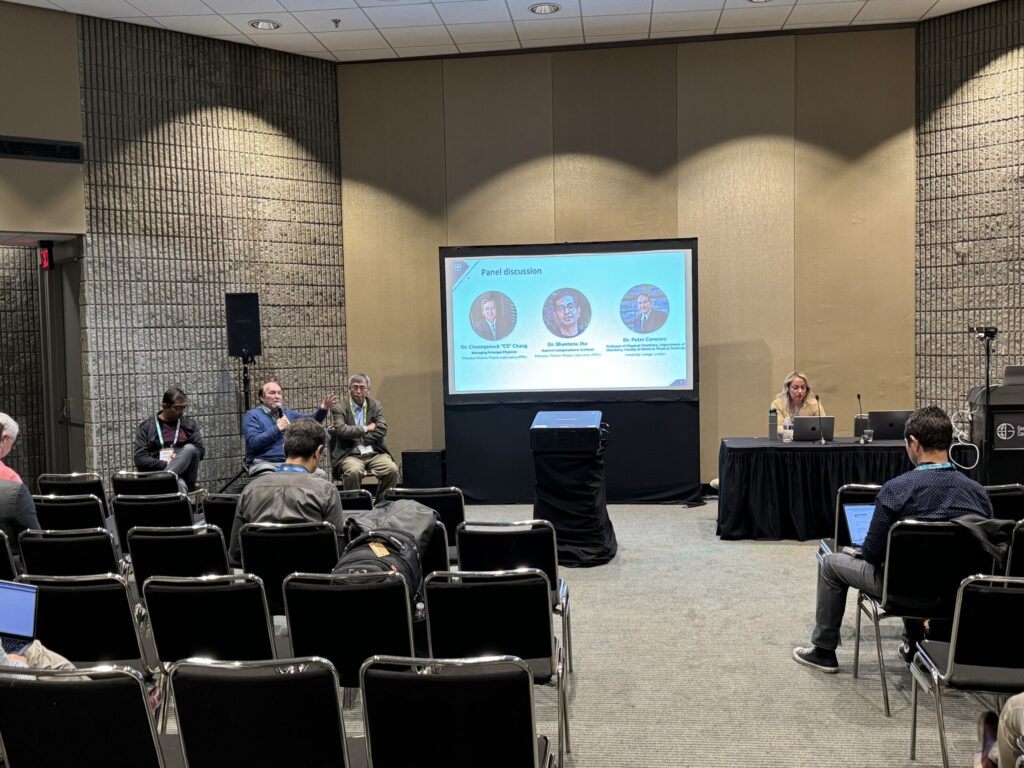
| Panel discussion | Peter Coveney, Shantenu Jha, CS Chang | 20 min. 10:30am: 11.30am |
| Scrutinizing Variables for Checkpoint Using Automatic Differentiation | Huang, Zhang, Meng, Xu, Fu, Guo, Sato | 20 min. 11:30am-11:50am |
| Optimizing Uncertainty Estimation on Scientific Visualizations Using Learning Models | Pautsch, Guerrero-Pantoja, Almeida, Pantoja, Rizzi, Thiruvathukal | 20 min. 11:50am-12:10pm |
| Closing Remarks, OLCF/SNL updates, best paper announcement | Georgiadou, Casey | 20 min. 12:10pm-12:30pm |
Sponsors 2024


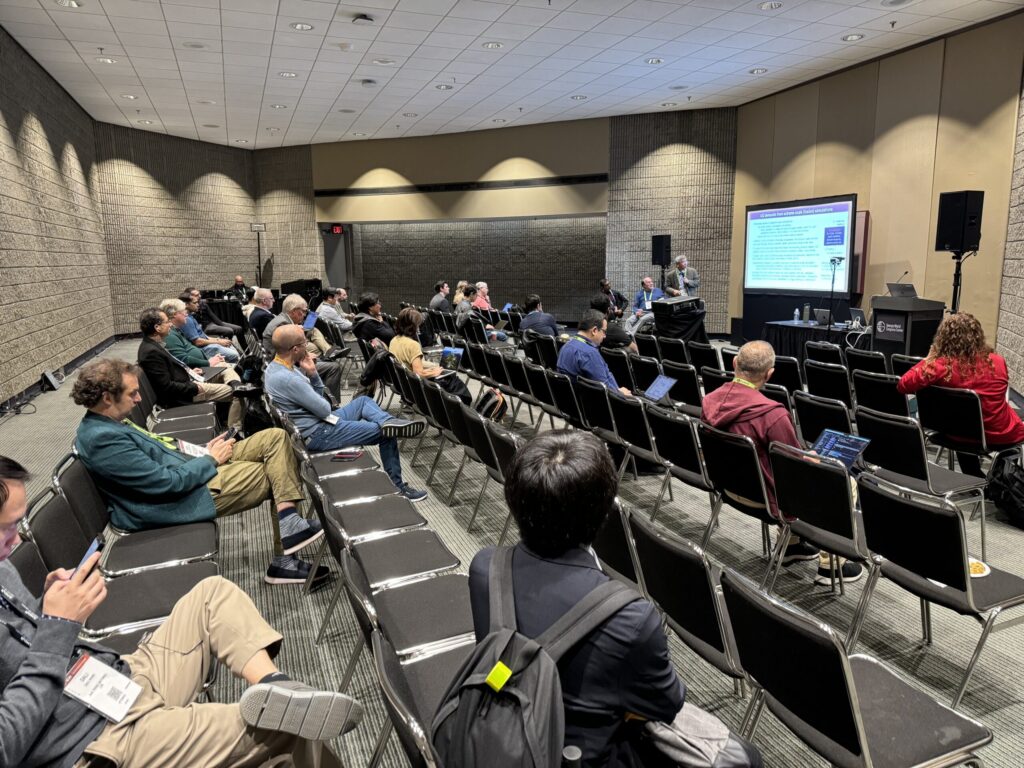
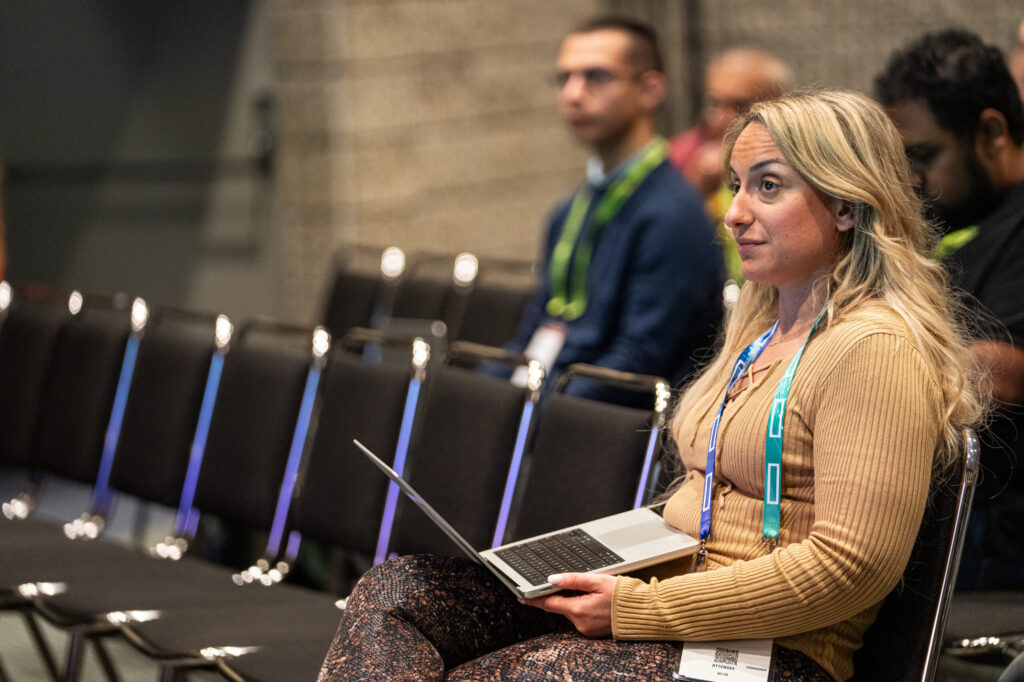
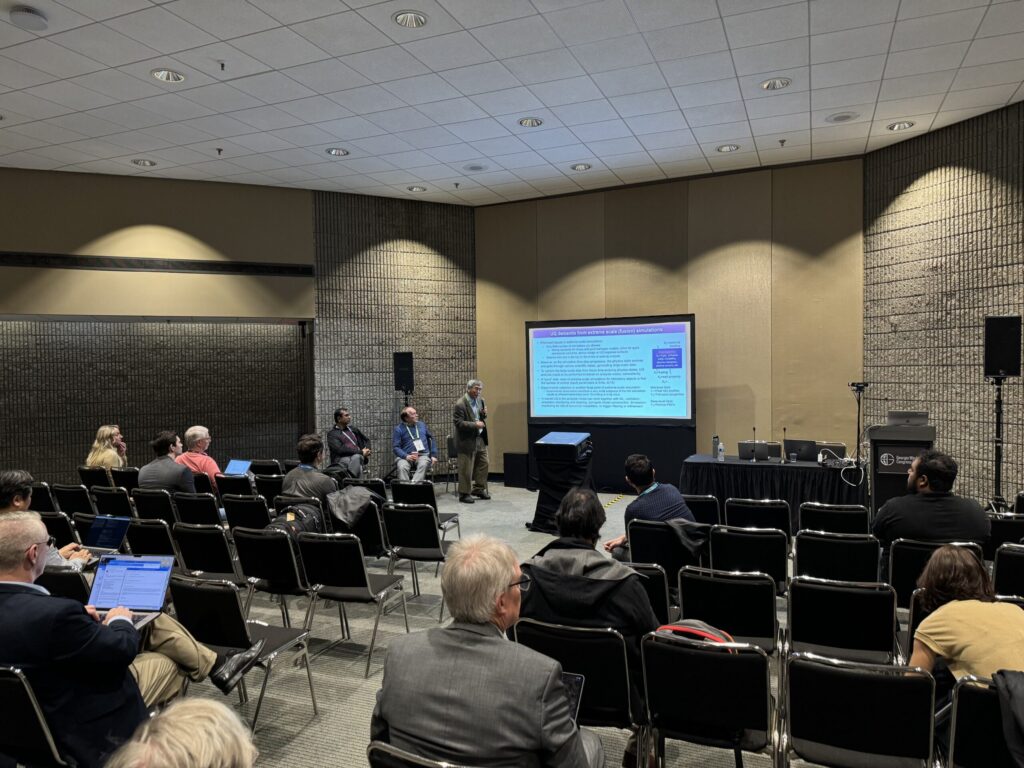
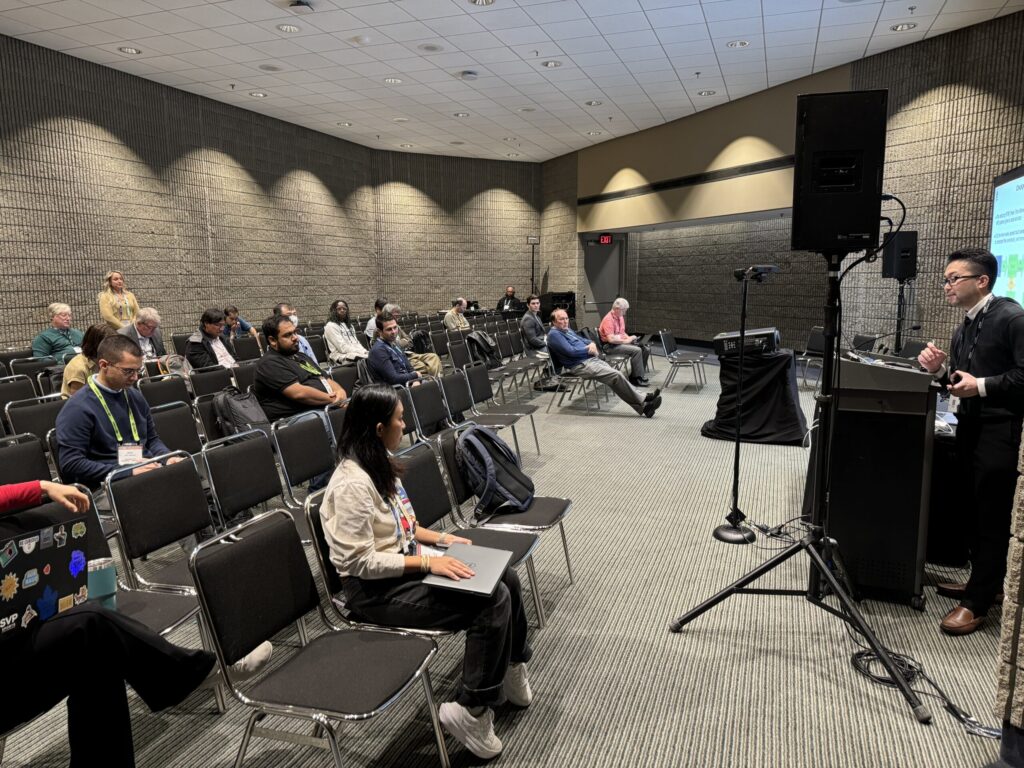
Gallery 2024