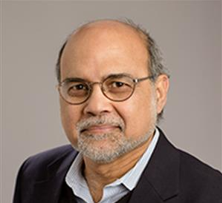
Dr. Rizwan Uddin is professor and head of the Department of Nuclear, Plasma, and Radiological Engineering at the University of Illinois. He also holds a courtesy appointment of Professor, Institute for Sustainability, Energy and Environment (iSEE), and serves on the steering committee of iSEE at the University of Illinois at Urbana-Champaign. He is also the Director of Master of Engineering in Energy Systems Program, as well as Environment and Sustainability Engineering (EaSE) Program in the Grainger College of Engineering. He received his BS in Mechanical Engineering from Middle East Technical University (Orta Doğu Teknik Üniversitesi) in Ankara, and his MS and Ph.D. degrees in Nuclear Engineering from the University of Illinois. He has made seminal research contributions in the development and analysis of: two-phase flow and boiling water reactor (BWR) stability; advanced numerical methods for thermal hydraulics problems, CFD, and large scale, high performance computing for nuclear applications; analytical benchmarks for heat transfer problems; and new self-consistent turbulence models and associated closure laws for flow in porous media. He also dabbles in the development and use of 3D immersive, virtual reality systems and computer-games for education and training in the nuclear field.
Four of his Ph.D. advisees have been awarded the American Nuclear Society’s Mark Mills Award for the “best original technical paper contributing to the advancement of science and engineering related to the atomic nucleus.” He was awarded the American Society of Engineering Education’s Glenn Murphy Award in 2015, American Nuclear Society’s Arthur Holy Compton Award for his teaching and research accomplishment (2016), and 2017 UIUC’s Campus Award for Excellence in Guiding Undergraduate Research. He is a Fellow of the American Nuclear Society.
Presentation Title:
Towards “V&V” for Robust AI and Agentic AI-based Science and Engineering
Presentation Abstract:
This talk overlaps the three themes identified for this workshop. It will touch upon “uncertainty aware inferences” from the first part; and “scientific workflows” from part ii. If time permits, some recent progress toward integration of AI+digital-twin+human-factors+VR/AR will also be discussed. Building on the long established V&V process in modeling and simulation community of nuclear science and engineering, we will discuss the need to develop a similar “V&V” process for knowledge generated using AI and Agentic AI. Brief outline of a potential process to establish robustness will be discussed in the context of a specific case of duplication of previously reported scientific results using AI, identification of omissions and mistakes discovered by AI, and evaluating the reliability of “new” results generated by AI. The iterative back-and-forth process with the AI platforms may help guide us toward the development of a new V&V-type process even for Agentic AI.