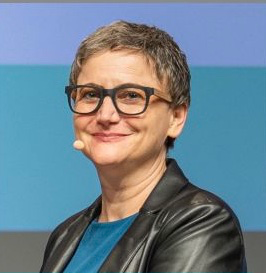
Michela Taufer is the MathWorks Professor at the University of Tennessee, Knoxville. She is an ACM Distinguished Scientist, an IEEE Senior Member, a Fellow of the American Association for the Advancement of Science (AAAS), a member of the Board of Directors of the Computing Research Association (CRA), and a member of the Computing Community Consortium (CCC). She is the recipient of the 2025 IEEE/ACM International Symposium on High-Performance Parallel and Distributed Computing (HPDC) Achievement Award.
Her research spans high-performance computing, cloud computing, and artificial intelligence and machine learning (AI/ML)-driven workflows, with an emphasis on reproducibility, scalability, transparency, and data-centric scientific discovery. She has made pioneering contributions to volunteer computing, accelerator-based supercomputing, performance portability, and the development of FAIR (Findable, Accessible, Interoperable, and Reusable) data frameworks, including the National Science Data Fabric (NSDF). Taufer leads interdisciplinary collaborations among universities, U.S. national laboratories—including Lawrence Livermore National Laboratory (LLNL), Los Alamos National Laboratory (LANL), and Oak Ridge National Laboratory (ORNL)—and industry partners, including IBM and MLCommons, to advance AI-enabled scientific discovery, workflow automation, and sustainable cyberinfrastructure. Her work has advanced modern approaches to scientific data management, reproducible computing, and autonomous scientific workflows for data-intensive research.
Presentation Title:
From Research to Operations: Building a National Digital Backbone for Autonomous Science with ORNL
Presentation Abstract:
Artificial intelligence is shifting scientific discovery from post-experiment analysis to an active role in experimentation, enabling real-time decisions, adaptive experiments, and autonomous labs. Achieving this requires not just advanced models but also cyberinfrastructure that securely connects facilities, data, computing, and researchers across institutions.
This talk introduces the National Science Data Fabric (NSDF), an NSF-supported national digital backbone for AI-driven science built on federated data, interoperable services, and FAIR cyberinfrastructure. It will highlight growing collaboration between NSDF and Oak Ridge National Laboratory (ORNL), where joint research is becoming operational infrastructure for autonomous experimentation. NSDF and ORNL are linking neutron instruments, AI services, high-performance computing, and remote collaborators while preserving facility security and local governance.
The presentation will cover recent demonstrations integrating ORNL neutron facilities with AI-driven workflows and complementary deployments at the Cornell High Energy Synchrotron Source (CHESS). These examples show how a shared federated architecture can support real-time data movement, interactive visualization, provenance tracking, and AI-guided experimental decisions across facilities. They illustrate how reusable cyberinfrastructure co-developed with ORNL is maturing from prototypes to production-ready capabilities deployable across scientific domains.
The talk will conclude with how this partnership lays the groundwork for a national ecosystem of autonomous science, where facilities, AI, and researchers function as an integrated, distributed system. By combining NSF investments in open cyberinfrastructure with ORNL’s strengths in facilities and computing, NSDF is enabling a scalable operational model that accelerates discovery and broadens access to advanced scientific capabilities.