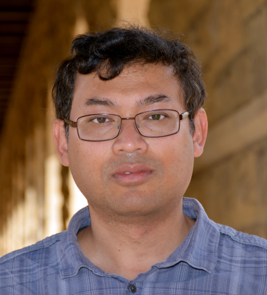
Soumyendu Sarkar is Senior Director and Senior Distinguished Technologist at Hewlett Packard Enterprise, where he leads machine learning research at HPE Labs. His work spans reinforcement learning, optimization, generative AI, and agentic systems for sustainable infrastructure and scientific discovery. He advances AI-agent-enabled data center control that coordinates compute, cooling, energy storage, and workload placement, enabling data centers to act as responsive participants in the electric grid.
Soumyendu is also a Principal Investigator on U.S. Department of Energy programs in inertial confinement fusion and AI Co-Principal Investigator for the Genesis Mission. His team develops an Agentic Fusion Copilot combining physics-grounded generative models, reinforcement-learning planning, digital twins, and agentic LLMs for autonomous experiment design and real-time scientific co-piloting. He has collaborated with the University of Rochester’s Laboratory for Laser Energetics and Lawrence Livermore National Laboratory, and serves as HPE’s Principal Investigator for the NIST AI Consortium. Before HPE, he was a Distinguished MTS at Bell Labs and a senior manager at Intel.
Presentation Title:
From Autonomous Infrastructure to Autonomous Discovery: Agentic AI for Data Centers and Genesis Fusion Copilot
Presentation Abstract:
Agentic AI is extending scientific and engineering workflows beyond prediction toward systems that can reason, plan, invoke tools, evaluate outcomes, and operate under physical constraints. This session presents the Genesis Mission Agentic Fusion Copilot, a physics-grounded architecture for scientist-supervised inertial fusion experiment design and real-time experimental co-piloting. The system combines generative models for physically realizable implosion designs, a differentiable radiation-hydrodynamics engine, physics-consistent surrogates, reinforcement-learning planning, and an agentic interface to experimental data and scientific knowledge. Together, these capabilities support rapid design evaluation, multi-step planning, explanation, and refinement within limited inter-shot decision windows. The presentation connects this work to agentic control of data centers, where digital twins, reinforcement learning, and AI agents coordinate compute, cooling, energy storage, and workload placement. Across both domains, the central challenge is the same: enabling bounded autonomy through physics grounding, uncertainty-aware escalation, tool integration, human oversight, and auditable decisions.